

The Life of the Saguaro Cactus: Strength Forged in the Desert


Standing tall against an Arizona sunset, the saguaro cactus is one of the most recognizable symbols of the American Southwest. With its towering green trunk and arms reaching toward the sky, it can look almost like a silent guardian watching over the desert.
But there is something remarkable about the saguaro that you might never guess by looking at a mature one.
Every towering saguaro begins as a seed no bigger than a tiny black speck.
And its journey from that little seed to a desert giant can take well over a century.
Life Begins With a Tiny Seed
The saguaro cactus (Carnegiea gigantea) is native to the Sonoran Desert, particularly southern Arizona and northwestern Mexico.
Its life often begins during the summer rainy season.
A mature saguaro produces beautiful white flowers that are pollinated by bats, birds, bees, and other desert visitors. Those flowers eventually develop into bright red fruit filled with thousands of tiny black seeds.
But producing thousands of seeds doesn't mean thousands of new saguaros will survive.
Far from it.
The desert is a difficult place for a baby cactus. Seeds may be eaten by birds, ants, rodents, and other animals. Others land where there isn't enough moisture to germinate. Even those that sprout can quickly die from drought or extreme heat.
For one fortunate little seed, however, the journey continues.
Growing Up Under a Protector
Young saguaros frequently get their start beneath what scientists call a nurse plant.
Trees and shrubs such as palo verde, mesquite, and ironwood can provide precious shade from the intense desert sun. They create a slightly cooler, more protected environment where a tiny cactus has a better chance of surviving.
And tiny really does mean tiny.
Saguaros grow incredibly slowly during their early years. After several years, a young saguaro may still be only a few inches tall. While everything around it seems to change, the little cactus quietly keeps growing.
Year after year. Rain after rain.
Built to Survive
A mature saguaro is essentially a giant living water-storage system.
When rain finally arrives in the Sonoran Desert, the cactus absorbs water through a wide network of shallow roots spreading outward around it. Its pleated outer surface allows it to expand as it takes in water. After a good rainfall, a saguaro can become noticeably fuller.
That stored water helps sustain it through the long dry periods that follow.
Instead of leaves, which would lose precious moisture in the desert heat, the saguaro has spines. Its green skin performs photosynthesis, allowing the plant to make food from sunlight without traditional leaves.
Everything about the saguaro seems designed for one purpose:
Keep going.
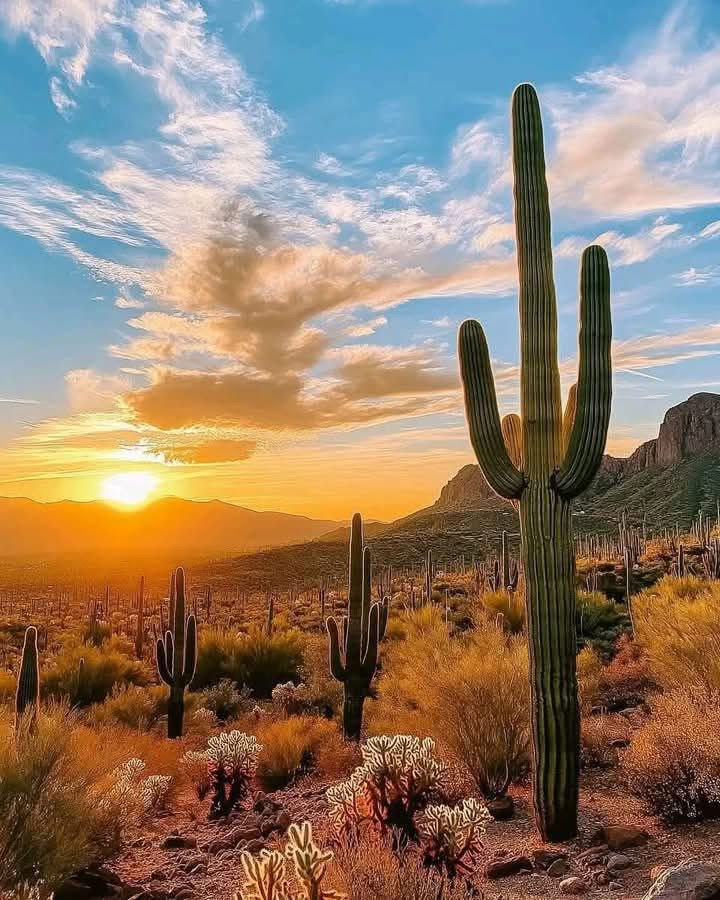
When Does a Saguaro Grow Arms?
One of the most interesting things about saguaros is that they don't start life with those famous arms.
For decades, they may simply grow straight upward like tall green columns.
Depending on growing conditions, a saguaro may be around 50 to 75 years old before its first arm appears. Some grow arms earlier, others much later, and some never develop arms at all.
There is no rule saying a saguaro has to have two arms -- or five -- or ten.
Every cactus develops differently.
Some become elaborate giants with numerous twisting arms. Others remain almost perfectly straight throughout their lives.
And maybe there's a little lesson in that.
A saguaro doesn't need to look like the one standing beside it to be exactly what it was meant to be.
The Desert Giant Blooms
Once mature, the saguaro becomes an important part of the desert's food supply.
In late spring and early summer, creamy white flowers appear near the tops of its trunk and arms. The saguaro blossom is so closely associated with Arizona that it became the state's official flower.
Those flowers don't last long, but while they're open, they're busy places. Bees visit them. Birds feed from them. Nectar-feeding bats arrive at night.
After pollination, the flowers produce red fruit filled with pulp and seeds. For generations, Indigenous peoples of the Sonoran Desert -- particularly the Tohono O'odham -- have harvested saguaro fruit as an important traditional food and cultural resource.
And inside that fruit waits the beginning of another generation. Thousands of tiny seeds.
A Home in the Desert
Saguaros don't just survive in the desert. They provide homes for other creatures.
Gila woodpeckers and gilded flickers can excavate nesting cavities inside saguaros. The cactus responds by forming hardened tissue around the cavity, creating what is sometimes called a saguaro boot.
After the original bird leaves, another desert resident may move in. Small owls and other birds can use abandoned cavities for nesting.
So that giant cactus standing quietly against the horizon may actually be filled with life.
Birds perch on its arms. Animals eat its fruit. Pollinators visit its flowers. Creatures shelter within it.
The saguaro doesn't merely endure its environment. It becomes part of what allows other life to endure, too.

A Century Beneath the Desert Sky
Saguaros can live extraordinarily long lives. Many live 150 years or more, with exceptional individuals potentially approaching two centuries.
Think about that for a moment.
A saguaro standing in the desert today may have sprouted before automobiles filled American roads, before airplanes crossed the skies, and before Arizona became a state in 1912.
Summer monsoons have rolled over it. Dust storms have surrounded it. Winter nights have chilled it. Generations of birds have nested inside it. People have come and gone.
And through all of it, the saguaro has continued reaching toward the sky.
Even Giants Have Scars
As tough as saguaros appear, they aren't indestructible.
Drought, freezing temperatures, disease, lightning, wind, and physical damage can leave their marks.
Some saguaros grow crooked. Some lose arms. Some develop scars. Some look nothing like the perfect cactus silhouette we imagine when we picture the Southwest.
And yet they continue growing.
Maybe that's another reason I love the saguaro so much.
Its beauty isn't about perfection. Its beauty comes from everything it has survived.
From the Desert to My Jewelry

That spirit is what inspired my Saguaro Earrings.
When I create jewelry inspired by the Southwest, I don't see the saguaro as simply another cactus. I see what it represents.
Strength. Endurance. Patience. Individuality.
A saguaro spends decades becoming what we recognize as that magnificent desert giant. It doesn't grow according to anyone else's timetable, and no two mature saguaros are exactly alike.
That feels especially fitting for handmade jewelry.
Each piece I create at Abood Elegant Journeys is made individually, and those small differences are part of what makes handmade jewelry special.
My Saguaro Earrings are a little piece of that Southwestern spirit -- a reminder to stand tall, embrace what makes you different, and keep growing through whatever season you're in.
One Tiny Seed
Eventually, another mature saguaro blooms.
A bat drinks from one of its flowers. A bird eats its fruit. Somewhere beneath a palo verde tree, one tiny black seed lands in just the right place.
Then the summer rain comes. The seed germinates. A nearly invisible green cactus begins pushing upward through the desert soil.
It may take years to grow a few inches. Decades to become tall. Perhaps half a century or longer before it grows its first arm.
And maybe, if the desert is kind to it, that tiny seedling will still be standing beneath the Arizona sky more than a century from now.
That may be the most beautiful thing about the saguaro.
It doesn't hurry. It doesn't try to become something else. It simply keeps growing.
And from a seed small enough to rest on your fingertip eventually rises one of the greatest giants of the American Southwest.
Wear your personality. Stand tall. And never underestimate what can grow from the smallest beginning.
Abood Elegant Journeys -- handmade jewelry inspired by nature, personality, and the beauty found along the journey.


Comments